Zhengzhou fangruizhenghe Machinery Manufacturing Co., Ltd
What are the differences between the sheet-forming type and
Author:admin source:未知 Release date:2026-01-15 13:44
Information summary:
The two main molding processes for fiber cement board equipment are the scraping type and the flow box type(flow molding).The core differences lie in four aspects:molding principle,equipment structure,board performance,and application scenar...
  The two main molding processes for fiber cement board equipment are the scraping type and the flow box type(flow molding).The core differences lie in four aspects:molding principle,equipment structure,board performance,and application scenarios.The details are as follows:

  1.Core differences in molding principle

  Scraping type:It mimics the papermaking process,mixing fibers,cement,quartz sand,etc.to form a low-concentration slurry.The slurry is adsorbed by rotating mesh cages(similar to paper machines'circular nets)to form continuous wet mats,which are then dehydrated and shaped by pressing.The entire process is a"adsorption-matting"mode,with a low slurry concentration.

  Flow box type:It adopts the flat-molding concept.The slurry is first mixed to a medium-high concentration,then evenly distributed in the flow box,and directly laid flat on the forming mesh belt.It is then subjected to vacuum dehydration and roller pressing for shaping.The entire process is a"flat-compacting"mode,with better controllable fluidity of the slurry.

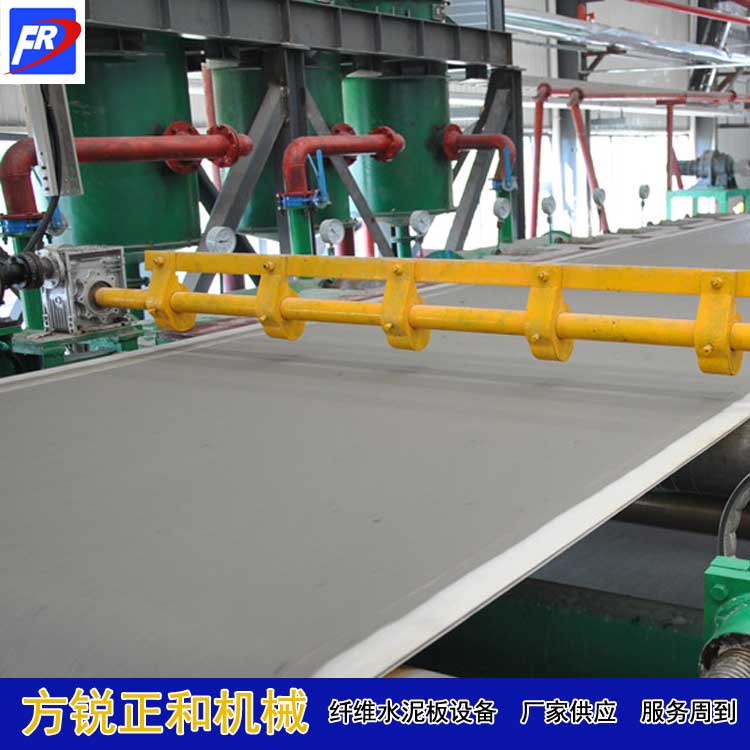
Cement fiberboard equipment
 
Cement fiberboard equipment   
       2.Performance differences of finished boards

  Thickness range

  Scraping type:Suitable for producing thin boards,with a thickness usually ranging from 3 to 6 mm.It is difficult to produce thick boards(thick boards are prone to delamination and uneven density).

  Flow box type:Can produce full-thickness boards,with thickness ranging from 3 to 30 mm.The density uniformity and structural stability of thick boards are better.

  Physical properties

  Scraping type boards:Fine texture,flat surface,small differences in strength between the transverse and longitudinal directions,but overall strength is low,suitable for decorative purposes.

  Flow box type boards:After heavy roller pressing,the density is high,with significantly better flexural strength,compressive strength,and moisture resistance and durability than scraping type.They are also more stable during vacuum dehydration and roller pressing for shaping.

  Defect rate

  Scraping type:Fibers are prone to clump together when adsorbed by the mesh cage,resulting in local defects.The defect rate is relatively high.

  Flow box type:The slurry is evenly distributed on the forming mesh belt,and the vacuum dehydration+roller pressing shaping process is more stable.The defect rate is lower,suitable for large-scale production.

  Differences in application scenarios of fiber cement boards

  Scraping type:Mainly for thin decorative boards,often used in interior wall decoration panels,ceiling panels,fireproof partition inner lining boards,etc.,where strength requirements are not high.

  Flow box type:Mainly for structural functional boards,which can be used as exterior wall hanging boards,floor slab lining boards,roof tile base boards,firewalls,etc.,where strength and durability have high requirements for building components.

contact us

contact usNational Service Hotline

+86 15237157661
Service Hotline:

+86 15237157661

Company email:

fangrui_machine@hotmail.com

company address:

No. 6, Jianye Road, Gongyi City

Technical Support: Tongchuang Network

Copyright© 2021 Gongyi Fangrui Zhenghe Machinery Factory